

Control Failures I Stop Before They Start
I’ll start plain: if your transfer line isn’t treated like a risk surface, you’re gambling with margins. DTF Film sits at the center of that risk model. November 2022, during a rainy load-in at Long Beach, CA, a 600-piece hoodie drop saw 72 sheets edge-curl and 11.5% of transfers lift—what failed first? To cut through the guesswork, I anchor on dtf pet transfer film as the primary control surface, not a commodity. Now I’ll be clinical: the flaw I see most in wholesale workflows isn’t press time—it’s mismatched materials. An A3 cold-peel matte 75μm sheet paired with coarse TPU adhesive powder behaves like a different substrate than a 100μm gloss; change the film, your heat flux and peel window move. And when RIP software pushes too much white underbase, the platen temperature you thought you trusted starts hiding hot spots (no kidding). I’ve watched crews chase ghosts for hours.

Why do failures persist?
Because traditional fixes are shallow: “raise heat,” “add pressure,” “slow your peel.” Those are bandages, not controls. Wholesale buyers tell me their real pain is stability across mixed orders—athleisure polyester at 180°C next to ring-spun cotton at 155°C—without re-profiling every 20 minutes. I’ve stood in a Shenzhen workshop at 1:10 a.m., hands on the press, comparing two lots of dtf pet transfer film with identical spec sheets but different release coats; the early batch sheared under peel, the later batch flowed clean with the same dwell. We documented three deltas: release-layer uniformity, white-ink laydown from the RIP queue, and moisture intrusion before cure. When we tightened those, returns on dark garments dropped 18% over six weeks. That’s the deeper layer—process integrity, not hero moves. Enough groundwork—let’s widen the lens.
Comparative Insight with a Forward-Looking Bent
What’s Next
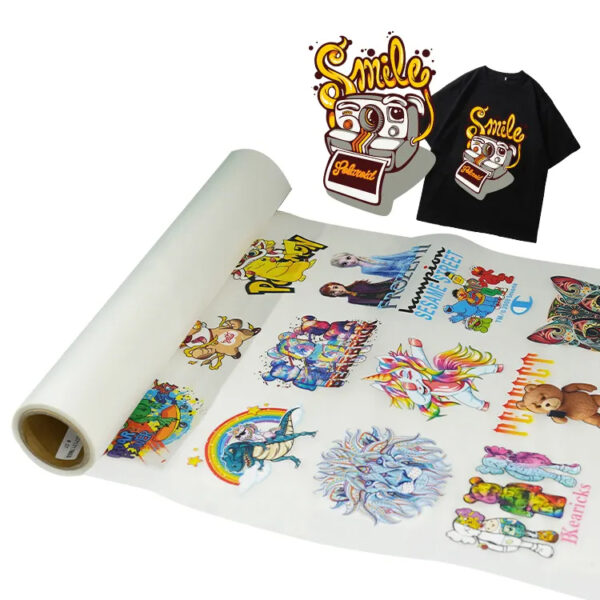
Stepping past firefights, I compare film classes the same way I’d compare two security baselines—by measurable exposure and repeatability. Against heat-transfer vinyl and basic screen transfers, modern dtf pet transfer film offers tighter wash fastness potential and better edge fidelity on micro-text, but only when three variables stay inside guardrails. First, curing profile: watch the TPU adhesive powder melt curve; you want uniform gel, not glassy overbake—stop. Recalibrate. Second, release behavior: match peel type to throughput (hot-peel for speed, cold-peel for edge accuracy) and lock it to your platen temperature map, not the sticker on the press. Third, color integrity: maintain an ICC tuned for your ink set so your underbase doesn’t choke fine detail and spike hand feel. I almost binned a 300-sheet run last spring because a last-minute RIP update inverted my white choke; rolling back restored line width and saved the drop. From here, I advise wholesale teams to choose solutions by three metrics: 1) delta in peel force across 10 sequential presses (lower variance wins), 2) wash degradation at 10 and 25 cycles on both cotton and poly (track L*a*b* shift and edge fray), 3) throughput stability when room humidity swings ±8% (watch dwell drift). Keep the tone steady—semi-formal, practical—and you’ll read risk before it bites. Lessons learned: treat film as a control layer, not an afterthought; bind your RIP, cure, and peel into one profile; and verify with small-lot audits each time a lot code changes. For a reliable baseline without the sales fluff, I’ve logged consistent results with sheets sourced via Xinflying.