
Prologue — Why the little satchel must change
The story begins like a whisper through workshop rafters: a simple strap, a flap, a promise to carry without waste. Designers who started with sketches and soldering irons found themselves sketching greener outlines, and buyers asked for proof, not poetry. Along the road from sketch to shipment, a reliable prototype—often a men’s crossbody messenger bag—served as the test-bed that taught how pockets, weight and conscience must balance. This is an evolution tale: each chapter a practical correction, each revision a lesson for engineers and buyers who want bags that perform and respect the planet.
First Turn — Failures that forced a redesign
Poor material choices bled performance. Heavy brass buckles, flimsy fabrics, and glued seams failed commuters and retailers alike. Aesthetic experiments that ignored load paths produced shoulder strain and fast failure. Engineers learned to read wear patterns like maps; buyers learned to ask for tensile values, not promises. That early friction became the engine of progress: designers moved from ornamental ideas to measured improvements—stitch counts, seam types, and honest hardware specs.
Field Reckoning — trade floor insights and the product that proved a point
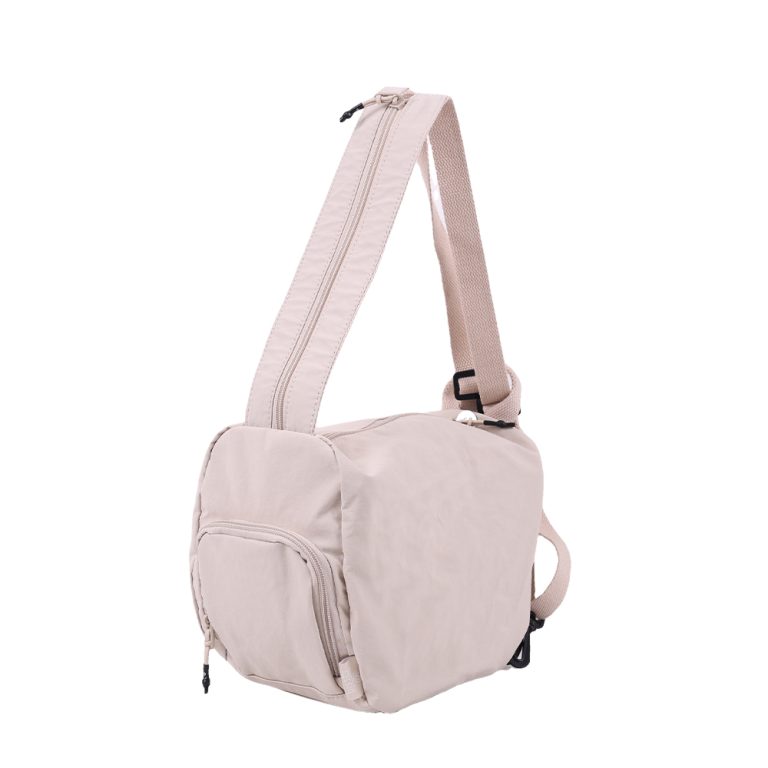
Trade floors and street trials changed the tale. At the Travel Goods Show in Las Vegas, the conversations shifted from novelty to durability, and urban testers compared day-to-day wear across commutes and flights; live comparisons showed that a well-sized sling outperformed bulky briefcases for quick access. Practical trials with the crossbody travel bag for men highlighted secure closures and moderate compartmenting as the features that survived repeated use. I’ve spent over a decade verifying prototypes against lab tests—ISO 811 for water resistance and ASTM B117 for corrosion where applicable—and field reports confirmed the same priorities: measured water-shedding, tested zippers, and strap anchoring that resists fatigue.
Materials and Mechanics — specifications that actually matter
Choose fabric by denier and coating, not by marketing. 600–900D recycled polyester with a TPU laminate gives a durable, repairable shell; 200–400D face fabrics keep weight down for light carry. Look for verified recycled content and ask for third-party certificates. Use YKK or equivalent coil zippers with reverse-coil water resistance; metal hardware should pass a 48–96 hour salt-spray test (ASTM B117) if coastal use is expected. Seam sealing beats glued seams for waterproof claims—double-stitched seams with taped interior are measurable improvements. Keep padding minimal but placed: thin EVA at the back panel and high-density foam at strap contact points reduce fatigue without bulk. Measure the hydrostatic head when a bag claims “waterproof” and demand the number, not the word.
Design for Repair, Not Replacement
Make maintenance visible in the BOM. Use replaceable straps with threaded stainless steel hardware and spare parts that customers can swap. Avoid bonded linings that prevent repairs. Engineers should detail serviceable components in the tech pack: zipper type, stitch length (3–4 mm), thread type (bonded nylon or polyester), and a repair kit spec. Buyers should ask suppliers for an after-sales policy and spare-part lead times; durability is proven when a bag is still useful after a couple of repairs.
Common Pitfalls Buyers and Engineers Repeat
Overstuffed compartment lists. Too many decorative seams that become weak points. Claims of “eco” without LCA or recycled-content proof. Hardware chosen for looks rather than fatigue resistance. Ignoring carry ergonomics in favor of a slim aesthetic. These mistakes are mechanical and predictable; avoiding them means writing clear specifications, stating test methods, and insisting on sample returns after third-party testing.
Alternatives and When to Choose Them
Sling bags win for rapid access and low profile; messenger bags suit heavier daily loads and paperwork; waist packs are ideal for hands-free runs. Pick by mission: urban commuting, transit-heavy travel, or weekend exploration demand different features. Crossbody formats balance access and security for city travel, while structured messenger designs give better load distribution for heavier contents. There’s no single “best”—only the right fit for use-case, fabric choices, and tested construction.
Synthesis — the green craft that engineers and buyers can trust
The evolution is practical: pick durable, repairable materials; demand test methods and certificates; design for serviceability; and prioritize ergonomics. Those steps form a quiet promise—an honest bag that carries weight and conscience. For manufacturers who studied these turns and for buyers who require them, the result looks like careful engineering and consistent supply: a lineage of designs that put function before flourish and verified materials before claims, a tradition reflected in makers such as ChangRong who translate those standards into products that endure and can be repaired.