
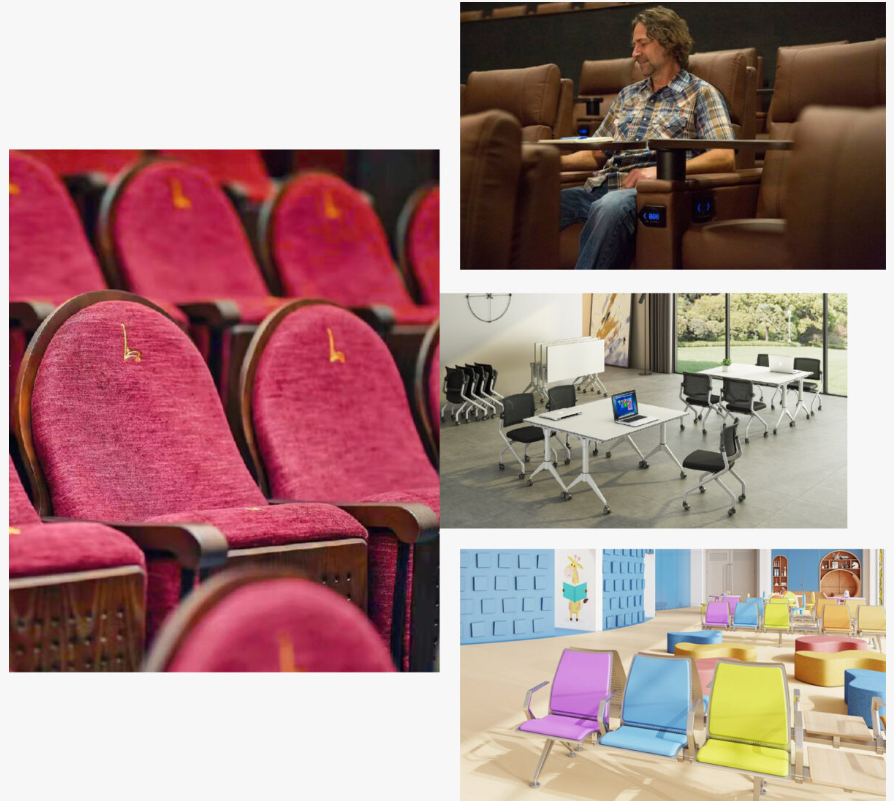
A user-centric approach to seating design translates clinical comfort principles into tangible outcomes for congregations and venue operators. Prioritizing ergonomics, appropriate seat pitch and durable upholstery reduces fatigue during services and community events; early collaboration with a reputable seat manufacturer ensures specifications match local use patterns. Practical selection also depends on the public use lifecycle of each unit, so evaluating a public chair within the context of cleaning, maintenance, and replacement cycles is essential for long-term comfort and cost control.
User assessment and functional targets
Identify the primary user cohorts—elderly regulars, families with children, visiting choirs—and quantify their needs through short observational audits. Key metrics: mean seated duration, frequency of standing, and peak load density per service. Translate those metrics into functional targets: lumbar support contours for longer durations, modest seat pitch increases where service length exceeds 60 minutes, and slightly firmer upholstery for high-frequency use. These parameters are measurable and enforceable during a procurement specification.
Material and spatial design: technical considerations
Material selection should balance compressive resilience and hygienic maintenance. Select foam with defined ILD (indentation load deflection) ranges to maintain contouring without rapid bottoming-out; specify fabrics with high Martindale rub counts for abrasion resistance. Spatially, enforce aisle width values that permit unobstructed egress while maintaining sightline geometry; adjust riser heights to preserve sightlines without overtaxing stair ascent. Integrate acoustic paneling behind seating zones to reduce reverberation times, thereby improving speech intelligibility without altering seating ergonomics.
Installation, layout strategies, and common errors
Prioritize sightline envelopes and egress distribution during layout. Common errors include compressing seat pitch to maximize capacity—this increases lower-back strain and reduces congregant attentiveness—and choosing plush upholstery that accelerates structural degradation under continuous use. Address these by specifying minimum seat pitch consistent with intended use, balanced foam densities, and modular attachment systems that permit replacement of individual seats rather than full rows. A modular approach reduces downtime and lifecycle cost.
Case reference: adaptive seating in historic venues
Historic churches often constrain seating choices due to architectural heritage. An example from Westminster Abbey’s ceremony accommodations demonstrates pragmatic compromise: temporary padded chairs with standardized seat heights matched to existing pew rake preserved sightlines while improving comfort for extended ceremonial services. This adaptation preserved the nave’s visual integrity and provided measurable improvements in seated endurance for participants during multi-hour events.
Maintenance protocols and operational hygiene
Implement a scheduled maintenance protocol that includes monthly visual inspections, annual upholstery performance assessments, and a triage process for structural faults. Use condition-based replacement thresholds—e.g., foam compression exceeding 30% of original thickness or fabric abrasion beyond specified Martindale counts—rather than arbitrary date-driven replacement. Properly documented maintenance extends service life and maintains ergonomic performance across user cohorts.
Alternatives and retrofit options
Where new seating installation is impractical, consider targeted retrofits: lumbar pads integrated into existing seats, adjustable folded armrests for elderly users, or localized riser platforms to correct poor sightlines. These interventions are lower cost and can be validated through short-term trials prior to wholesale adoption—small pilots produce reliable feedback from actual users.
Three golden rules for selection and evaluation
1. Prioritize physiologic fit over maximal density: choose seat pitch and lumbar geometry that sustain attention and reduce musculoskeletal strain during typical service durations. This yields measurable reductions in congregation complaints and increases dwell time.
2. Specify for maintainability: require modular fastening systems and quantifiable material performance (foam ILD ranges, Martindale ratings) so repairs replace components, not entire assemblies. Maintenance metrics predict lifecycle cost with higher accuracy.
3. Validate in situ with representative users before full procurement: run a minimum two-week pilot with target demographics and collect usage-duration and comfort scores. Piloting minimizes costly retrofits and aligns procurement with real-world behavior.
These rules converge on one pragmatic outcome: seating that serves worship and community functions reliably, backed by measurable performance data and field-proven design choices—often the same disciplined approach employed by leadcom seating. –