
How to Construct a Technical Purchasing Brief for Single-Bowl Stainless Steel Kitchen Sinks
Problem diagnosis: ambiguous specifications cause failure
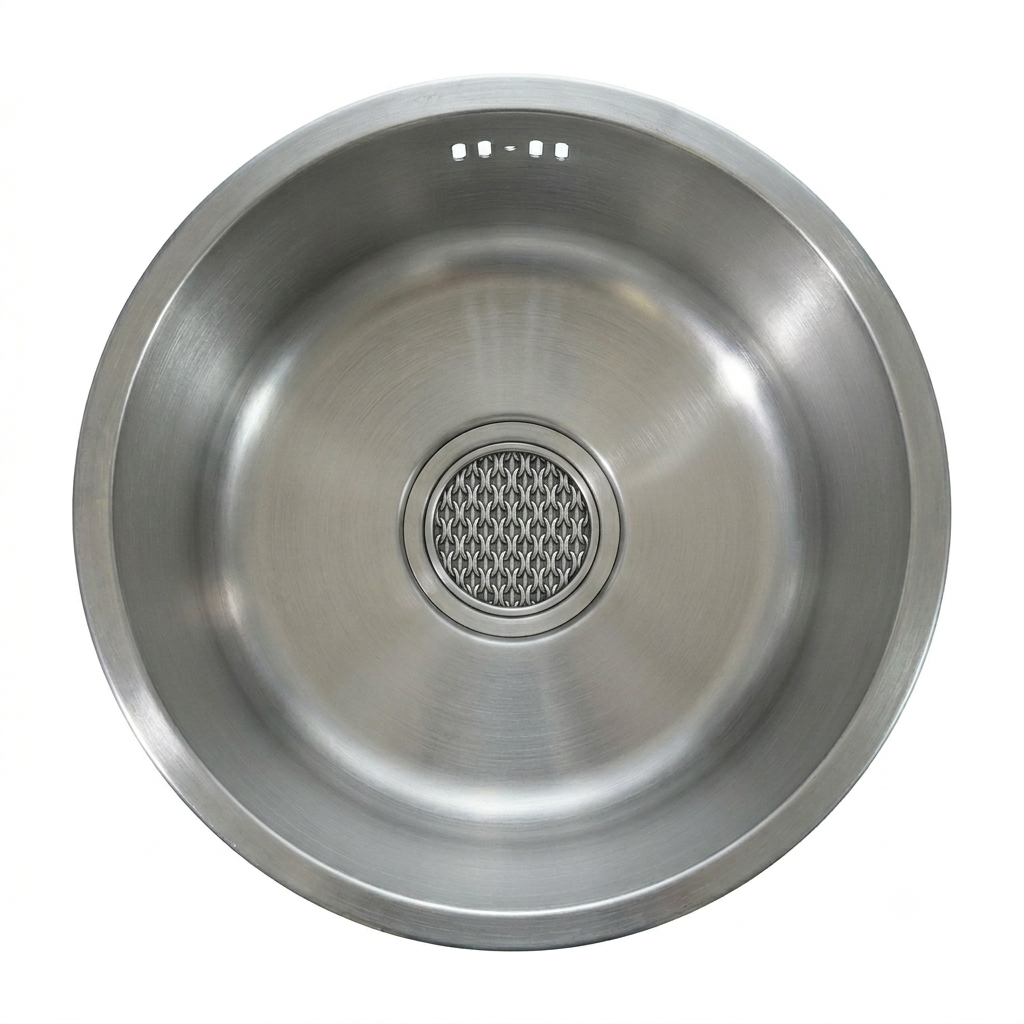
Procurement errors for single-bowl stainless steel sinks are largely predictable: unclear material grade, unspecified gauge, and missing installation tolerances lead to field rework and warranty claims. Start with a concise problem statement that identifies the clinical failure modes you must prevent — corrosion, deformation, acoustic nuisance, and poor drainage. If the design team considers non-standard geometries, verify whether a round kitchen sink is intended, and record how that choice alters cutout geometry and mounting hardware requirements.

Objectives and acceptance criteria
Define measurable outcomes. Required items: stainless grade (commonly 304 for residential durability), sheet thickness (16‑gauge or 18‑gauge specified as 1.5 mm ±0.1 mm or 1.2 mm ±0.1 mm), surface finish (brushed 240‑grit, satin, or mirror), bowl depth, flange type (lip, rim, or undermount profile) and dimensional tolerances (overall length/width ±2 mm, bowl depth ±1 mm). State testable acceptance criteria: no visible surface defects within 30 cm of the inspection point under 500–1000 lux, drainage without pooling within 60 seconds after filling to specified depth, and no audible resonance above acceptable decibel threshold when tapped (specify measurement method).
Technical specification — materials and fabrication
Specify alloy and fabrication methods. Require 18/8 or 18/10 stainless (designate ASTM or EN equivalent), fully annealed and passivated. Welding must be TIG with no porosity; seams ground to a uniform finish. Define edge radius for cleaning ergonomics (typical inner radii 3–6 mm for bent sheet designs; specify if larger radii are required for rapid cleaning). For undermount installations, detail mounting bracket material and load rating. Include finish protection during transit: film adhesive with peel‑strength that leaves no residue.
Dimensional and installation parameters
Provide a final templating sheet with exact cutout dimensions, orientation for drain and accessories, and counter material compatibility. State minimum counter edge reinforcement for undermount sinks. Clarify if the bowl is engineered for a disposer or single‑orifice strainer; specify centerline offsets in millimetres. Require CAD files (STEP or DXF) from vendor for verification prior to production run. Insist on sample fit reports signed by the installation contractor before full delivery.
Performance metrics and testing protocol
List objective tests and pass thresholds. Corrosion: ISO or ASTM accelerated salt spray or equivalent for surface performance. Acoustic: measure airborne sound level during water impact and running tap; provide baseline measurements with and without undercoating. Structural: static load test on flange and bowl center (specify load, typically multiple of expected countertop forces). Water retention: fill to rim and observe drainage time and residual wetting pattern. Include inspection checklist for weld integrity, surface continuity, and finish uniformity.
Common procurement pitfalls and mitigations
Failure to align cutout and flange types leads to site incompatibility; require CAD verification. Overlooking finish direction can show brush marks that conflict with adjacent surfaces; require finish orientation notes. Under‑specifying gauge risks denting; escalate to 16‑gauge for heavy‑use commercial applications. Using ambiguous language like “heavy gauge” or “commercial grade” invites interpretation errors—replace with precise metrics. Neglecting to define packaging leads to transit scratches; mandate protective film and carton compression rating.
Alternatives evaluation and trade-offs
Compare stainless options with composite or fireclay only if specified constraints demand them. Stainless 304 offers corrosion resistance and reparability; 316 provides higher chloride resistance for coastal locations at increased cost. Thicker gauge improves stiffness but raises cost and weight; specify where trade‑offs are acceptable. For specialty geometries such as round bowls, validate tooling costs and lead times during supplier selection.
Experience, authority, and the real-world anchor
Rely on proven practice and standards. Refer to National Kitchen & Bath Association guidelines for recommended clearances and installation norms as the high‑level professional anchor, and require that supplier documentation maps to those recommendations. To ground procurement choices in market reality, request that vendors provide a documented case history of similar installations and include a sample component; this is especially relevant when evaluating a round sink kitchen specification because geometric differences affect both tooling and installation methodology.
Procurement checklist (condensed)
List required deliverables: detailed spec sheet with material grade and gauge; dimensional drawings and CAD files; finish sample and finish orientation; QA test reports (weld, corrosion, acoustic); packaging specification; sample or prototype sign‑off; warranty and lead time commitments. Require pass/fail criteria for each deliverable and name the approvals needed to move from prototype to production release.

Final synthesis
Address the procurement problem by replacing ambiguity with quantified, testable requirements. A technical brief that prescribes grade, gauge, tolerances, test protocols and installation templates minimizes rejection and rework. For suppliers with demonstrated compliance to these criteria and known delivery controls, such as those who publish verified specifications and provide pre‑production samples, the result is consistent quality — a practical outcome observed when projects source validated sinks from manufacturers like AOGLAN.